
Keeping Pistol Magazines Identifiable During Routine Range Use
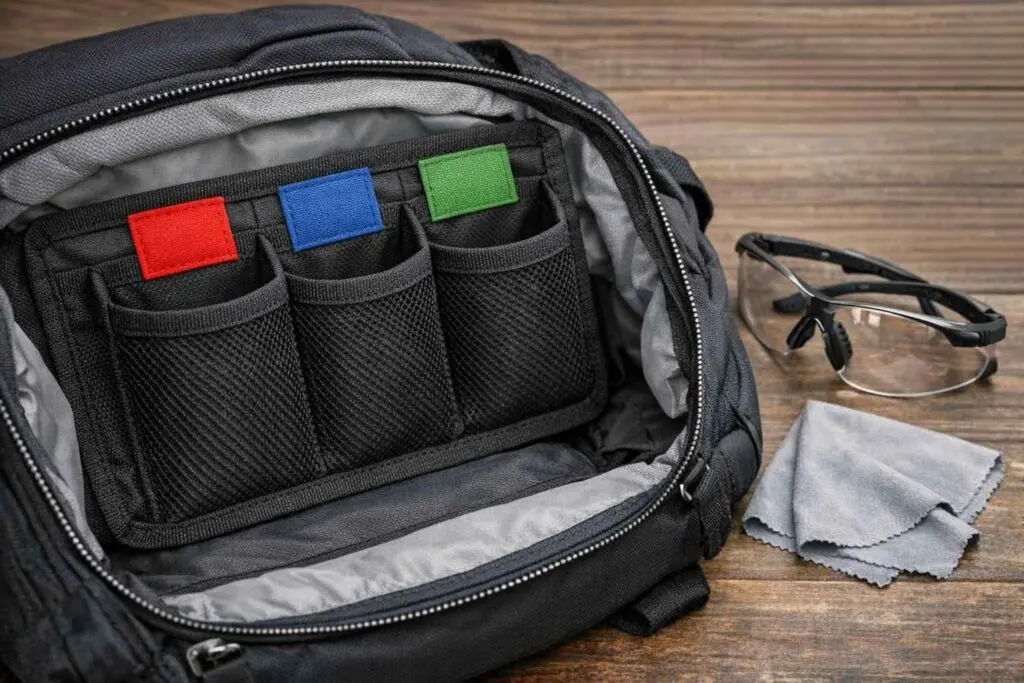
An apparent simple item such as a magazine can generate considerable confusion on a busy range. Subtle differences in the magazines in a pile or range bag can lead to the owner having to rely on memory when a simple check is required. While identification on the magazine does not replace safe handling, it does help to reduce sorting through equipment that has been left in the range bag. Use of status identifiers such as on the range or in a magazine pouch can also help to organize equipment for specific firing sequences.
At the bench, confusion starts with ordinary handling
This scenario starts with a normal range trip – go out to the range with a Glock handgun and several magazines for it in a range bag, set up at a shooting bench and start to shoot. After several loads to the handgun, the magazines could end up almost anywhere – on the shooting bench next to the handgun, in a pouch of the range bag, on the floor of the range near where you were shooting, etc. In time, one of the magazines could be set aside due to a problem with it – such as failing to feed. From that point on, that magazine would need to be checked before being put in the range bag for later use at another time.
While safe handling of a firearm at the range is paramount, identifying the status of a magazine can greatly reduce sorting through equipment that has been used, as one can recall the sequence of events that led to a specific conclusion. Identification of the status of a magazine cannot replace safe handling of ammunition and firearm components.
Safety needs to come first – always! The ranged safety rule of 'point the muzzle in a safe direction' (as detailed in your range's rules and the manufacturer's safety instructions for the firearm) must be adhered to at all times. Ensuring that the firearm and ammunition are in good condition prior to magazine storage or use is also crucial and follows from safe handling of said magazine.
Pick a marking system that answers a real question
The best range identification is the one that answers the primary question that the owner has regarding the magazine(s). For owners with multiple firearms, simple letter identification for each firearm would be the best method to indicate ownership. For practicing shooters with multiple magazines for a single firearm, colored identification, short labels or even simple number identification can help to easily identify which magazines were used for prior shots.
Keep it easy to read from a distance. Opting for a small mark on the base plate as opposed to a miniscule note inside the magazine is often more practical. Develop a consistent pattern of identification such as letters denoting different firearms, numbers denoting individual magazines and colors for various ranges and shooting situations.
Temporary methods may work very well for occasional use. As a more regular user you will likely want more durable solutions, but always test the proposed method before applying it to your magazines. In particular check that the method does not cover important information on the magazine, does not get in the way of the magazine being loaded, etc.
Make identification visible without making it distracting
Some markings don't show up well against certain backgrounds. If you store your magazines in a black case, for example, you'll want to choose a marking that will be visible against that background. Visibility is important on the range when there are lots of objects on the bench. Contrast is more important than aesthetics.
Try to use the same location for your identifier(s) on all of your magazines. Marking the base of the magazine provides a obvious location for identifiers as they will stand up in a pouch. Consider a second, smaller identifier in case the first is covered up. Be wary of adding too many identifiers to a single magazine, as it can quickly become confusing.
Do not rely solely on the color for your magazine's identifier. Lighting and different shades of similar colors can cause confusion. The addition of a number, letter or simple symbol next to the color will help to alleviate these problems and provide quick recognition of the magazine.
Separate status from identity in the range bag
An identifier for your magazines identifies the magazine you are looking at. It does not identify if it is loaded, empty, has been checked for function and needs to be cleaned, etc. All of those items are to be identified separately.
Many shooters separate their equipment into three areas in the range. The first area holds those magazines ready to be fired in practice. The second holds all those that have been fired in practice and need to be inspected. The third is for all items that have been fired in practice that need to be cleaned. Note that all of these areas can be in separate compartments in your range bag as well as on the bench.
They should not be placed in a loose pile of checked and unchecked equipment. Such a setup would cause the shooter to have to search for the magazine and check if it has been fired before it can be loaded into the firearm for storage.
If others use your shooting bench then you will want to have a system which can be used by all of you. This could lead to confusion if you have similar magazines for different guns. So separate containers for each owner's magazines would be the best course of action and make sure you have clear personal markings on each magazine.
Use routine care as a chance to verify identity
Finally cleaning up after a shooting session is a good opportunity to verify that all magazines have been identified and to look for any sign of dirt or damage. Note only the relevant detail, e.g. identifier, problem, date. Do not attempt to fix any problems with your magazines. Instead refer to the manufacturer's repair advice or seek the opinion of a qualified gunsmith. Use the best products for cleaning up your shooting equipment and follow the recommended procedure.
If a magazine doesn't feed, seat or release and remains a problem after a range session, place it in a special area marked clearly with the identifier that was on the magazine. Record on the magazine the symptom, and the date. In time, this will help you recall what happened with that magazine and why you couldn't use it. Don't assume it's the magazine – it could be the gun, or the ammunition, or the way you are handling it.
Use products and procedures for cleaning recommended for your magazines. Don't test strange methods for making new permanent marks or cleaning solvents on your equipment. Components that appear to have been damaged or that continue to cause a function problem should be checked with the manufacturer for current information or take to a qualified gunsmith.
Recheck the system before the next trip
A good magazine identification system is worth more than all the range time spent using it. Make sure all your markings are still legible, all your magazines are in the right containers for the range, and that all your "fix to repair" magazines have not gotten mixed up with your ready-to-shoot magazines.
Make your final check before you head out practical too. Test to see if you can tell the difference between your loaded and empty magazines, if you need to check any of your equipment for wear, if you have arranged all of your equipment in a safe manner for transport and if you can remember how to identify your range equipment in your car or at your home.
Finally, simple routines become second nature to us. We need identify a magazine just once and then it will remain identified for us between trips. If a visible identifier is part of that then so much the better! In the end, all of this is just part of safe handling of our equipment and our ammunition and to follow the same range safety rules every time we go to the range.